
Myth, Empire, and Misread Symbols
When we say “Thursday” or “Wednesday,” we rarely stop to consider that these names are over a thousand years old. Hidden within the English week are traces of Babylonian astronomy, Roman religion, Germanic mythology and Old Norse language. Far from being arbitrary, the names of the days reveal how different civilizations understood the heavens and adapted one another’s beliefs over centuries.
This article explores how the English days of the week developed, why some are named after Norse gods, why Saturday is the exception, and why some calendars begin with Sunday while others begin with Monday.
Before There Were Weekdays
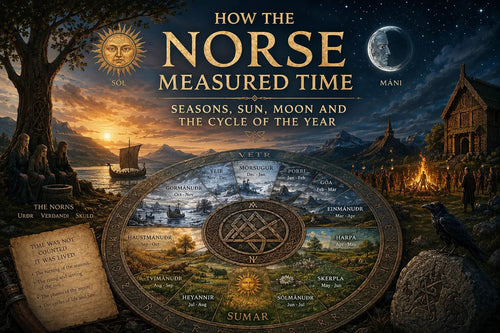
Early civilizations did not all divide time into seven-day weeks. Most measured time using natural cycles: sunrise and sunset, the phases of the Moon, changing seasons and the annual movement of the Sun.
Ancient Egypt used a ten-day week for much of its history. The Romans originally followed an eight-day market cycle known as the nundinal cycle. Other cultures divided time differently or had no formal week at all.
The seven-day week developed gradually and eventually became dominant through the influence of Babylonian astronomy, the Roman Empire and later Christianity.
Babylon and the Seven Wandering Lights
The earliest known origins of the seven-day week are generally traced to ancient Mesopotamia, particularly Babylon, where astronomer-priests carefully observed the heavens.
Unlike the thousands of fixed stars, seven celestial bodies appeared to move independently across the sky. Ancient observers called them the “wandering stars”:
- Sun
- Moon
- Mercury
- Venus
- Mars
- Jupiter
- Saturn
Today we understand that the Sun is a star and the Moon is Earth’s natural satellite, but to ancient astronomers they belonged to the same group because all seven moved differently from the background stars.
These seven celestial bodies became associated with divine powers, and the number seven gradually acquired religious and astronomical significance throughout the ancient Near East.
Although historians continue to debate exactly how the seven-day week developed, Babylonian astronomy provided the foundation that later civilizations adopted and adapted.
From Babylon to Rome
Greek scholars inherited much of Babylonian astronomical knowledge and connected each of the seven celestial bodies with one of their own gods. The Romans later adopted this system, replacing the Greek gods with Roman equivalents.
By the first centuries AD, the Roman Empire widely used a seven-day planetary week.
Each day was dedicated to a celestial body represented by a deity.
|
Latin Name |
Celestial Body |
Roman Deity |
Meaning |
|
Dies Solis |
Sun |
Sol |
Day of the Sun |
|
Dies Lunae |
Moon |
Luna |
Day of the Moon |
|
Dies Martis |
Mars |
Mars |
Day of Mars |
|
Dies Mercurii |
Mercury |
Mercury |
Day of Mercury |
|
Dies Iovis |
Jupiter |
Jupiter |
Day of Jupiter |
|
Dies Veneris |
Venus |
Venus |
Day of Venus |
|
Dies Saturni |
Saturn |
Saturn |
Day of Saturn |
It is important to note that these names were not simply religious. They also reflected the Roman understanding of astronomy, in which each visible celestial body was associated with a divine figure.
The seven-day week spread throughout the Roman Empire and eventually reached the Germanic peoples of northern Europe.
The Germanic Translation
The Germanic peoples did not simply copy Roman religion.
Instead, they translated Roman gods into their own pantheon, a process modern historians call interpretatio germanica (“Germanic interpretation”).
Rather than abandoning their beliefs, they identified gods who fulfilled similar roles.
This is why English does not preserve Mars, Mercury or Jupiter, but instead honours Tyr, Odin and Thor.
The seven-day structure remained Roman.
Many of the names became Germanic.
The English Days Explained
Sunday
Latin: Dies Solis (Day of the Sun)
Old English: Sunnandæg
Old Norse: Sunnudagr
Sunday is one of the few days that remained almost unchanged across Roman, Germanic and Norse traditions. Both cultures associated the day with the Sun, although the Norse personified the Sun as the goddess Sól.
Modern English, German (Sonntag), Dutch (Zondag) and the Scandinavian languages all preserve this ancient solar origin.
Monday
Latin: Dies Lunae (Day of the Moon)
Old English: Mōnandæg
Old Norse: Mánadagr
Like Sunday, Monday is another direct translation rather than a replacement.
The Romans associated the Moon with the goddess Luna, while the Norse understood the Moon as Máni, the brother of Sól.
Across Germanic languages, Monday has changed very little over the past thousand years.
Tuesday
Latin: Dies Martis (Day of Mars)
Old English: Tīwesdæg
Old Norse: Týsdagr
Mars was the Roman god of war.
The Germanic peoples identified his closest equivalent as Tyr (Old Norse: Týr), an ancient god associated with warfare, justice and honour.
Although Thor later became more widely known, Tyr appears to have been one of the earliest and most important Germanic deities.
Tuesday therefore means Tyr’s Day, not Mars’ Day.
Wednesday
Latin: Dies Mercurii (Day of Mercury)
Old English: Wōdnesdæg
Old Norse: Óðinsdagr
Wednesday is one of the most surprising translations.
Mercury was the Roman god of travellers, commerce, communication and guidance.
The Romans themselves compared Mercury with Odin (Old English: Woden), partly because both were associated with wisdom, travel, magic and guiding souls between worlds.
The Roman historian Tacitus even described the chief deity of several Germanic tribes as equivalent to Mercury.
Modern English still preserves this ancient association in the name Wednesday, derived from Woden’s Day.
Thursday
Latin: Dies Iovis (Day of Jupiter)
Old English: Þunresdæg
Old Norse: Þórsdagr
Jupiter ruled thunder and lightning in Roman mythology.
The Germanic equivalent was Thor, the god of thunder, storms and protection.
This translation was so natural that nearly every Germanic language still preserves Thor’s name.
Every Thursday, English speakers unknowingly honour one of the best-known gods of Norse mythology.
Friday
Latin: Dies Veneris (Day of Venus)
Old English: Frīgedæg
Old Norse: Frjádagr
Friday is the most debated weekday among historians.
The Roman day honoured Venus, goddess of love, beauty and fertility. The Germanic replacement is traditionally understood to be Frigg, wife of Odin and goddess associated with marriage, motherhood and foresight.
However, some scholars argue that the name may instead refer to Freyja, another prominent Norse goddess associated with love, beauty, fertility and magic. Frigg and Freyja share several overlapping characteristics, and it remains uncertain whether they originated as separate deities or developed from a common earlier tradition.
For this reason, Friday is usually translated as Frigg’s Day, although the debate continues.
Saturday
Latin: Dies Saturni (Day of Saturn)
Old English: Sæternesdæg
Old Norse: Laugardagr
Saturday is unique.
Unlike the other weekdays, the English name did not replace the Roman god with a Germanic one. Instead, it preserved Saturn almost unchanged.
Why?
No one knows for certain.
The most widely accepted explanation is that Saturn had no obvious equivalent in Germanic mythology.
Mars could become Tyr.
Mercury could become Odin.
Jupiter could become Thor.
Venus could become Frigg.
Saturn, however, represented agriculture, sowing, old age, prosperity, time and the legendary Golden Age. These roles were spread among several figures in Germanic belief rather than concentrated in one deity.
Rather than inventing a direct replacement, Old English simply retained the Roman name.
The Norse took a different approach.
Instead of preserving Saturn, they renamed the day Laugardagr, meaning “Bath Day” or “Washing Day.” Medieval Scandinavians were noted for bathing and washing regularly, often before gatherings, markets or religious observances. Over time, this weekly custom became the name of the day itself.
The tradition survives today:
|
Language |
Saturday |
|
Icelandic |
Laugardagur |
|
Norwegian |
Lørdag |
|
Danish |
Lørdag |
|
Swedish |
Lördag |
While English preserved Rome, Scandinavia preserved a custom.
Why Is Sunday the First Day of the Week?
Not all calendars begin on the same day.
Historically, Sunday was regarded as the first day of the week in Jewish tradition. In the Book of Genesis, God creates the world in six days and rests on the seventh. The seventh day became the Shabbat (Saturday), making Sunday the first day of a new week.
Early Christians inherited this weekly structure but also regarded Sunday as the Lord’s Day because it commemorated the resurrection of Jesus. As Christianity spread across Europe, many calendars continued to place Sunday first.
Today, countries such as the United States and Canada commonly display calendars beginning with Sunday.
However, much of Europe, including the Nordic countries, Australia and New Zealand, follows the international standard ISO 8601, which defines Monday as the first day of the week for business and civil purposes. This standard was introduced to improve consistency in international communication, computing and commerce.
Neither system is inherently more correct; they reflect different historical and practical traditions.
Is English a Norse Language?
Because English preserves Odin, Thor and Tyr in its weekdays, it is often assumed that English comes directly from Old Norse.
It does not.
Old English and Old Norse are sister languages, both descending from an earlier language called Proto-Germanic.
The relationship can be simplified as follows:
Proto-Indo-European
│
Proto-Germanic
├─────────────┐
Old English Old Norse
│ │
Modern English Modern Scandinavian Languages
During the Viking Age (8th–11th centuries), Scandinavian settlers brought Old Norse to Britain. Because the two languages were closely related, they influenced one another extensively.
Modern English still contains hundreds of Old Norse loanwords, including:
- sky
- window
- knife
- law
- husband
- egg
- they
- them
- their
The weekday names therefore reflect a shared Germanic heritage rather than direct borrowing from Viking settlers.
Weekdays Around the World
Although the seven-day week is now nearly universal, different cultures preserved different naming traditions.
|
Language |
Sunday |
Monday |
Tuesday |
Wednesday |
Thursday |
Friday |
Saturday |
Naming System |
|
English |
Sunday |
Monday |
Tuesday |
Wednesday |
Thursday |
Friday |
Saturday |
Germanic/Norse gods (except Saturday, which preserves the Roman Saturn) |
|
Old English |
Sunnandaeg |
Monandaeg |
Tiwesdaeg |
Wodnesdaeg |
Thunresdaeg |
Frigedaeg |
Saeternesdaeg |
Germanic gods adapted from the Roman week |
|
Old Norse |
Sunnudagr |
Manadagr |
Tysdagr |
Odinsdagr |
Thorsdagr |
Frjadagr |
Laugardagr |
Sun, Moon, Norse gods, and “Washing Day” |
|
Icelandic |
Sunnudagur |
Manudagur |
Tysdagur |
Odinsdagur |
Thorsdagur |
Fostudagur |
Laugardagur |
Mostly Old Norse names |
|
Norwegian |
Sondag |
Mandag |
Tirsdag |
Onsdag |
Torsdag |
Fredag |
Lordag |
Mostly Old Norse names |
|
Danish |
Sondag |
Mandag |
Tirsdag |
Onsdag |
Torsdag |
Fredag |
Lordag |
Mostly Old Norse names |
|
Swedish |
Sondag |
Mandag |
Tisdag |
Onsdag |
Torsdag |
Fredag |
Lordag |
Mostly Old Norse names |
|
German |
Sonntag |
Montag |
Dienstag |
Mittwoch |
Donnerstag |
Freitag |
Samstag |
Mixed Germanic tradition; Wednesday means “Mid-week” |
|
Dutch |
Zondag |
Maandag |
Dinsdag |
Woensdag |
Donderdag |
Vrijdag |
Zaterdag |
Mostly Germanic; Saturday preserves Saturn |
|
French |
Dimanche |
Lundi |
Mardi |
Mercredi |
Jeudi |
Vendredi |
Samedi |
Mostly Roman/Latin names (Sunday later Christianized) |
|
Spanish |
Domingo |
Lunes |
Martes |
Miercoles |
Jueves |
Viernes |
Sabado |
Mostly Roman names (Sunday and Saturday Christianized) |
|
Italian |
Domenica |
Lunedi |
Martedi |
Mercoledi |
Giovedi |
Venerdi |
Sabato |
Mostly Roman names (Sunday and Saturday Christianized) |
|
Hebrew |
Yom Rishon |
Yom Sheni |
Yom Shlishi |
Yom Revi’I |
Yom Chamishi |
Yom Shishi |
Shabbat |
Numbered days ending with the Sabbath |
|
Arabic |
Al-Ahad |
Al-Ithnayn |
Ath-Thulatha |
Al-Arbia |
Al-Khamis |
Al-Jumu’ah |
As-Sabt |
Mostly numbered days; Friday is the day of congregation |
|
Turkish |
Pazar |
Pazartesi |
Sali |
Carsamba |
Persembe |
Cuma |
Cumartesi |
Persian, Arabic and Turkish influences; no planetary or Norse gods |
|
Hindi |
Ravivar |
Somvar |
Mangalvar |
Budhvar |
Guruvar |
Shukravar |
Shanivar |
Named after the Sun, Moon and planets (same planetary tradition as Rome, but through Sanskrit) |
|
Japanese |
Nichiyobi |
Getsuyobi |
Kayobi |
Suiyobi |
Mokuyobi |
Kinyobi |
Doyobi |
Named after the Sun, Moon and the Five Elements/planets |
|
Chinese (Mandarin) |
Xingqi Ri |
Xingqi Yi |
Xingqi Er |
Xingqi San |
Xingqi Si |
Xingqi Wu |
Xingqi Liu |
Numbered weekdays; Sunday means “Day of the Sun” or “Week Day”depending on the form |
This comparison shows that while the seven-day structure spread widely, cultures adapted the names to fit their own languages, religions and traditions.
Summary
The English days of the week are the product of more than two thousand years of cultural exchange.
- The Babylonians identified the seven visible celestial bodies.
- The Greeks associated them with their gods.
- The Romans organised the seven-day planetary week.
- The Germanic peoples translated most Roman gods into their own mythology.
- The Anglo-Saxons preserved those names in Old English.
- The Vikings reinforced a shared Germanic tradition and contributed many Old Norse words to English.
- Saturday remained Roman in English but became Washing Day in Scandinavia.
- Today, nearly every country follows the seven-day week, even though many still use different calendars for religious and cultural purposes.
The next time you read a date, remember that your calendar is more than a tool for organising appointments. It preserves layers of astronomy, language, mythology and history that have survived from the ancient world into everyday life.
Further Reading
Primary Sources
- The Poetic Edda
- The Prose Edda
- Germania
Academic Works
- Rudolf Simek — Dictionary of Northern Mythology
- John Lindow — Norse Mythology: A Guide to Gods, Heroes, Rituals and Beliefs
- H. R. Ellis Davidson — Gods and Myths of Northern Europe
- E. G. Richards — Mapping Time: The Calendar and Its History
- Stephen Pollington — The Elder Gods
- Anthony Aveni — Empires of Time: Calendars, Clocks and Cultures
Recommended Reference Websites
- Oxford English Dictionary (weekday etymology)
- Encyclopaedia Britannica (Babylonian astronomy, Roman calendar, Germanic languages)
- The British Museum (Mesopotamian astronomy and Roman history)
- National Museum of Denmark (Viking Age and Old Norse culture)


0 comments