
Raw honey is honey that has been extracted from the honeycomb and minimally processed before bottling. Unlike many commercial honeys, it is not subjected to high heat or extensive filtration, allowing it to retain its natural composition, including pollen, enzymes, and other naturally occurring compounds.
What is it?
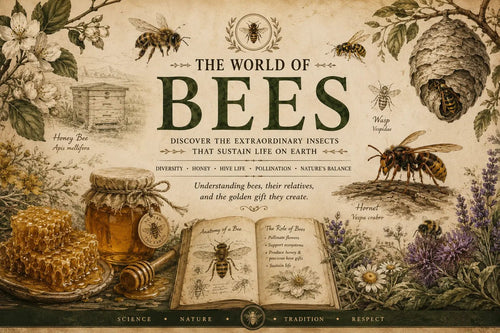
Honey is a natural sweet substance produced by honey bees (Apis mellifera) from the nectar of flowering plants. Bees collect nectar, transform it using enzymes, reduce its water content inside the hive, and store the finished honey in wax combs.
The term raw honey generally refers to honey that has not been significantly heated or ultra-filtered after extraction. Exact definitions may vary between producers and countries.
Origin
Honey has been produced by bees for millions of years and collected by humans for at least 8,000 years, as shown by ancient cave paintings in Spain depicting honey gathering.
Today, raw honey is produced worldwide, with each variety reflecting the flowers available to bees in its local environment. This gives every honey a unique colour, flavour, aroma, and composition.
How is it produced?
Worker bees collect nectar from flowers and store it in a special “honey stomach.” Back at the hive, the nectar is passed between bees, where natural enzymes begin breaking down complex sugars.
The nectar is deposited into honeycomb cells, and bees fan their wings to evaporate excess water. Once the honey reaches the proper moisture level, the cells are sealed with beeswax.
Beekeepers harvest the honey by removing the wax caps, spinning the frames in an extractor, and straining the honey before bottling. Raw honey is typically bottled without high-heat processing or ultra-filtration.
History & Traditional Uses
Honey has been valued for thousands of years as both a food and a natural sweetener.
Ancient Egyptians, Greeks, Romans, Chinese, and many other cultures used honey in cooking, religious ceremonies, traditional medicine, and food preservation. Throughout history, it has also been applied to the skin and incorporated into a wide range of traditional remedies.
These uses reflect historical traditions and should not be interpreted as evidence of proven medical benefits.
Naturally Occurring Compounds
Raw honey naturally contains a wide variety of compounds, including:
- Natural sugars (primarily fructose and glucose)
- Water
- Enzymes, such as invertase, glucose oxidase, and diastase
- Amino acids
- Organic acids
- Trace vitamins
- Trace minerals
- Polyphenols
- Flavonoids
- Bee-derived proteins
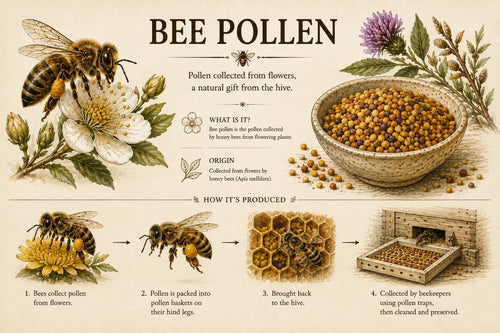
- Small amounts of pollen
The exact composition varies depending on the floral source, climate, season, and region where the honey was produced.
Interesting Facts
- Honey is one of the few foods that can remain edible for extremely long periods when stored correctly.
- The colour of honey can range from nearly clear to very dark amber depending on the flowers visited by bees.
- Raw honey naturally crystallises over time. Crystallisation is a normal process and is not a sign that the honey has spoiled.
- Every batch of honey is unique because bees forage from different flowering plants throughout the season.
How We Use It at EirHolt
At EirHolt, we use raw honey because it is a minimally processed whole food that retains its naturally occurring characteristics. Our honey products are carefully selected from trusted beekeepers and are never blended with refined sugars or artificial ingredients.
Related Reading
Products Containing This Ingredient
Information on this page is provided for educational purposes only and is not intended as medical advice. Historical and traditional uses do not necessarily reflect current scientific evidence.
0 comments