
Seasons, Sun, Moon and the Cycle of the Year
Time governs every aspect of human life. Long before clocks, watches and digital calendars, people understood time through the rhythms of nature. The rising and setting of the Sun, the changing phases of the Moon, the migration of animals and the arrival of each season shaped daily life far more than numbers on a clock.
For the Norse, time was not an abstract system to be measured precisely. It was a natural cycle that determined when to plant crops, harvest grain, sail across the sea, gather for assemblies and celebrate religious festivals. Their understanding of time developed from careful observation of the natural world rather than mechanical calculation.
Although the Norse eventually adopted the seven-day week and many aspects of the Christian calendar, their older traditions reveal a worldview closely connected to the landscape and the changing seasons of Scandinavia.
This article explores how the Norse measured time, how they divided the year, the role of the Sun and Moon in mythology, the festivals that marked the seasons and how their understanding of time differed from many later cultures.
Before Clocks: Measuring Time Through Nature
Every civilization developed methods of measuring time but not all used the same units.
The ancient Egyptians divided the year according to the flooding of the Nile.
The Babylonians carefully observed the movements of the Sun, Moon and planets.
The Maya developed highly sophisticated calendars based on astronomical cycles.
The Norse, living in the harsh climate of northern Europe, relied primarily on seasonal change.
Unlike Mediterranean civilizations, where agriculture followed four distinct seasons, Scandinavia was traditionally understood as having two principal halves of the year:
- Summer
- Winter
This division reflected practical life rather than astronomy. Farming, hunting, trade and seafaring all depended on whether the land was entering its productive or dormant season.
Instead of asking, “What month is it?”, people were often more concerned with whether winter had begun, whether the seas were navigable or whether livestock needed to be brought indoors.
Nature—not mathematics—was the primary calendar.
The Norse Year
The traditional Old Norse calendar divided the year into two great seasons:
Summer (Sumar)
and
Winter (Vetr).
Rather than beginning on 1 January, the Norse year was structured around seasonal transitions.
Winter generally began in mid-October with the festival known as Vetrnætr (“Winter Nights”), while summer traditionally began around mid-April with Sigrblót (“Victory Sacrifice” or “Summer Sacrifice”).
This six-month division reflected the realities of life in Scandinavia.
Winter brought darkness, snow and limited travel.
Summer brought long daylight hours, farming, fishing, trade and voyages across the North Atlantic.
Even today, traces of this ancient division remain in Icelandic tradition where historical references often describe events as occurring “one winter later” rather than one year later.
Months in the Old Norse Calendar
Unlike the modern Gregorian calendar, Old Norse month names varied across regions and periods. Iceland preserves the best-recorded medieval tradition.
Some of the best-known month names include:
|
Old Norse Month |
Approximate Modern Period |
Meaning |
|
Gormánuður |
October–November |
Slaughter Month |
|
Ýlir |
November–December |
Yule Month |
|
Mörsugur |
December–January |
Fat-Sucking Month |
|
Þorri |
January–February |
Midwinter Month |
|
Góa |
February–March |
Late Winter |
|
Einmánuður |
March–April |
One Month Before Summer |
|
Harpa |
April–May |
Beginning of Summer |
|
Skerpla |
May–June |
Summer Continues |
|
Sólmánuður |
June–July |
Sun Month |
|
Heyannir |
July–August |
Hay Harvest |
|
Tvímánuður |
August–September |
Double Month |
|
Haustmánuður |
September–October |
Harvest Month |
Unlike the Roman calendar, these names describe the activities, weather or agricultural conditions associated with each period of the year.
They provide valuable insight into what mattered most in everyday Norse life.
The names tell us less about politics or religion than about farming, food storage, survival and preparation for the coming winter.
Rather than counting time abstractly, the Norse named it according to the work that needed to be done.
Measuring Time Without Clocks
Modern life measures time by minutes and seconds. For the Norse, however, such precision was neither possible nor necessary. Their understanding of time was practical, shaped by the landscape, weather and changing light rather than mechanical devices.
The Sun, Moon and stars were the world’s oldest timekeepers.
The Beginning of the Day
Unlike today, there was no universally agreed moment when a new day began.
Many medieval Scandinavian communities appear to have regarded the day as beginning at sunset or in the evening, a tradition also found among several other ancient cultures.
This practical approach reflected everyday life. Evening marked the end of labour, the return of livestock, shared meals and preparation for the following day.
As Christianity spread through Scandinavia, methods of reckoning the day gradually aligned more closely with broader European customs.
Measuring Daylight
Without clocks, daylight itself became a measure of time.
People divided the day according to familiar events rather than fixed hours.
Instead of saying:
“Meet me at 3:00.”
A person was more likely to describe time using natural reference points:
- Dawn
- Sunrise
- Mid-morning
- Midday
- Afternoon
- Sunset
- Twilight
- Nightfall
These descriptions varied throughout the year because daylight in Scandinavia changes dramatically between seasons.
Near the summer solstice, daylight can last almost twenty-four hours in northern regions.
During winter, daylight becomes scarce.
A rigid system of equal hours would have been far less useful than simply observing the Sun.
Sól and Máni
Unlike modern astronomy, Norse mythology personified the Sun and Moon.
The Sun was Sól, a goddess who drove the Sun across the sky in a chariot.
The Moon was Máni, her brother, who guided the Moon’s journey through the heavens.
According to the Prose Edda, both were pursued by wolves across the sky.
The wolf Sköll chased Sól.
The wolf Hati pursued Máni.
This myth explained the continuous movement of the Sun and Moon while symbolising the relentless passage of time.
At Ragnarök, the wolves finally catch their prey. The Sun disappears, darkness covers the world and the familiar order of time is broken before a renewed world emerges.
Although these stories belong to mythology rather than astronomy, they demonstrate how the Norse understood celestial movements through narrative while still relying on careful observation of nature in everyday life.
Nótt and Dagr
Day and night were also personified.
Nótt represented night.
She rode across the sky on horseback, bringing darkness to the world.
Her son, Dagr, followed behind, carrying daylight.
Rather than viewing day and night as opposing forces in conflict, Norse mythology presents them as part of an eternal rhythm.
Each gives way to the other.
Neither can exist without its counterpart.
This reflects a recurring theme throughout Norse belief: balance through cycles rather than permanence.
The Moon and the Passing of Months
While the Sun determined the agricultural year, the Moon remained important for shorter periods of time.
The word month itself derives from the Moon, a connection preserved across many Germanic languages.
The changing lunar phases provided an easily observed natural cycle lasting approximately twenty-nine and a half days.
Although the medieval Icelandic calendar was primarily a solar calendar adjusted for seasonal accuracy, ordinary people still observed the Moon for practical purposes, including travel, fishing and marking the passage of time.
This connection between the Moon and months appears across countless ancient cultures, demonstrating that before written calendars, the night sky was one of humanity’s most reliable clocks.
Reading the Stars
The Norse were accomplished navigators.
Long before magnetic compasses became common in northern Europe, sailors crossed the North Atlantic using a combination of experience, landmarks, ocean currents, prevailing winds and celestial observation.
At night, familiar stars helped maintain direction.
During daylight, the position of the Sun provided orientation.
This knowledge was not unique to the Norse. Polynesian navigators, Arab sailors and many other maritime cultures also developed sophisticated methods of celestial navigation long before modern instruments.
The Norse adapted these techniques to the challenging conditions of the North Atlantic, allowing voyages to Iceland, Greenland and even North America centuries before the age of European exploration.
Did the Vikings Use Sunstones?
One of the most intriguing ideas associated with Viking navigation is the so-called sunstone.
According to later Icelandic texts, a special crystal could help determine the Sun’s position even when hidden behind clouds.
Modern experiments with minerals such as Iceland spar suggest that this may have been physically possible under certain conditions.
However, direct archaeological evidence remains limited, and historians continue to debate how widely such stones were actually used.
The sunstone is therefore best understood as a plausible navigational aid rather than a proven everyday instrument.
Time Was Experienced, Not Counted
Perhaps the greatest difference between the Norse understanding of time and our own lies in what they considered important.
Modern society measures time with extraordinary precision.
Seconds. Minutes. Milliseconds.
The Norse measured time differently.
The first snowfall.
The return of migrating birds.
The blooming of wildflowers.
The cutting of hay.
The freezing of rivers.
The arrival of winter.
These natural events determined when communities travelled, farmed, traded, celebrated and prepared for the months ahead.
Time was not something separate from life.
It was life itself.
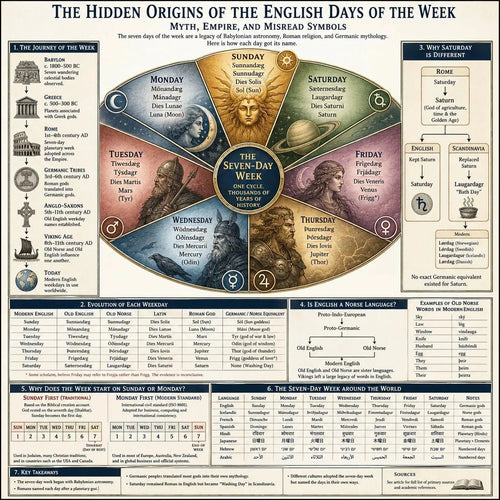
As we have already seen in our article on The Hidden Origins of the English Days of the Week, names and calendars preserve remarkable traces of ancient cultures. In the Norse world, however, the landscape remained the most important calendar of all.
Likewise, if you’ve already read our article exploring the 13-month calendar The Viking Calendar, the New Year and the Forgotten Rhythm of Time, you’ll recognise why many traditional calendars—including the Norse calendar—do not fit neatly into the modern Gregorian system. Rather than forcing nature into fixed dates, older calendars were often adjusted to remain aligned with the changing seasons.
The Sacred Year
For the Norse, time was not measured only by the passing of days or months. The turning of the year was marked by seasonal festivals that reflected agriculture, survival, kinship and religion.
These celebrations did not exist simply to honour the gods. They also marked practical moments in the farming calendar when livestock were brought home, when crops were planted, when winter stores were prepared and when communities gathered after long periods of isolation.
Although the exact dates and customs varied across Scandinavia, Iceland and other Norse settlements, several festivals are well documented through medieval Icelandic literature and later historical sources.
Vetrnætr – Winter Nights
The Norse year traditionally began with Vetrnætr (“Winter Nights”), celebrated around the middle of October.
Rather than seeing winter as the end of the year, it marked the beginning of a new seasonal cycle.
Livestock were brought indoors.
Harvests had been completed.
Food stores were prepared.
Ships returned to harbour before dangerous winter seas.
It was also a time for sacrifices (blót), feasting and seeking prosperity for the months ahead.
For farming communities, surviving winter was the greatest challenge of the year.
Beginning the calendar with winter therefore reflected practical reality rather than symbolism.
Yule
Perhaps the best-known Norse celebration is Yule (Jól).
Long before it became associated with Christmas, Yule marked the darkest period of the year and the gradual return of the Sun.
Feasting, gift-giving, storytelling and drinking were central to the celebration.
Animals were sacrificed.
Ale was brewed specially for the occasion.
Families and communities gathered indoors during the harshest part of winter.
Many customs now associated with Christmas including evergreen decorations, communal feasts, the Yule log and seasonal gift-giving have parallels in pre-Christian northern Europe, although their exact origins are often a blend of pagan and Christian traditions rather than belonging exclusively to one culture.
After the Christianisation of Scandinavia, many Yule traditions were absorbed into Christmas while retaining the Old Norse name. Even today, the Danish Jul, Norwegian Jul, Swedish Jul and Icelandic Jól preserve this ancient word.
Þorri and Midwinter
Around January and February came Þorri, one of the most difficult periods of the year.
Food stores were diminishing.
Travel remained difficult.
The landscape lay frozen.
In Iceland, Þorri is still remembered through the midwinter festival Þorrablót, revived during the nineteenth century as a celebration of Icelandic heritage.
Traditional foods served during Þorrablót reflect the realities of historic survival, making use of preserved meats, fermented foods and ingredients that could endure long northern winters.
Although the modern festival differs from medieval practice, it preserves the memory of one of the year’s most significant seasonal milestones.
Sigrblót – Welcoming Summer
Around mid-April, the Norse celebrated Sigrblót, often translated as the “Victory Sacrifice.”
The festival marked the arrival of summer and the beginning of the active season.
Fields were prepared.
Livestock returned to pasture.
Trading voyages resumed.
Warriors frequently departed on military expeditions once weather conditions allowed.
The word “victory” probably referred not only to success in battle but also to prosperity, successful harvests and favourable fortunes during the coming season.
This festival effectively marked the second half of the Norse year.
Dísablót
Another important celebration was Dísablót, dedicated to the dísir—female supernatural beings associated with family, protection and ancestral spirits.
The exact nature of the dísir remains uncertain.
Some scholars interpret them as protective goddesses.
Others see them as ancestral female spirits connected with family lineages.
Whatever their precise identity, Dísablót demonstrates that Norse religious life extended beyond the famous gods such as Odin and Thor.
Many rituals focused instead on family, fertility, protection and maintaining harmony between the living and those who came before them.
Álfablót
One of the most private Norse festivals was Álfablót, the sacrifice to the elves.
Unlike large communal gatherings, Álfablót appears to have been celebrated within individual households.
Visitors were often turned away.
Little is known about its rituals because Christian writers recorded very few details.
Its secrecy suggests that not every religious observance centred on public ceremonies.
Many belonged to the home and the family.
Assemblies and the Rhythm of Society
Seasonal festivals also determined when communities met for legal and political purposes.
The Thing, the Norse assembly was usually held during periods when travel was possible and agricultural demands were lower.
Here disputes were settled.
Laws were recited from memory.
Marriages arranged.
Trade conducted.
Political alliances formed.
Justice itself therefore followed the rhythm of the seasons.
Nature influenced not only farming but governance.
Christianity and the Changing Calendar
From the tenth century onward, Christianity gradually spread throughout Scandinavia.
The conversion did not erase older customs overnight. Instead, many traditions were adapted.
Yule became associated with Christmas.
Christian feast days entered the calendar.
Churches introduced new ways of recording years and religious observances.
The Julian calendar—and later the Gregorian calendar—eventually replaced regional Norse systems for civil life.
Yet many Old Norse month names, festivals and seasonal customs survived, particularly in Iceland, where medieval literature preserved valuable records of earlier traditions.
As with the weekday names explored in our previous article, the Norse calendar did not simply disappear. Much of it was woven into the new Christian society, leaving traces that remain visible today.
The Norns and the Flow of Time
At the foot of Yggdrasil, the great World Tree, lived three mysterious beings known as the Norns.
Their names are:
- Urðr
- Verðandi
- Skuld
They are often described as representing the past, present and future, but this is a simplification.
The meanings of their names are closer to:
- Urðr – “That which has become.”
- Verðandi – “That which is becoming.”
- Skuld – “That which ought to be” or “that which is yet to come.”
Rather than existing as separate moments, the three represent an unfolding process.
The past shapes the present.
The present shapes the future.
Time is continuous rather than divided into isolated parts.
According to Norse tradition, the Norns drew water from the Well of Urðr each day to nourish Yggdrasil and preserve the order of the world.
This image suggests that time itself required constant care and renewal.
Yggdrasil and the Order of the Cosmos
Yggdrasil is often described simply as the tree connecting the Nine Realms.
It also represents the structure upon which the Norse universe depends.
Its branches reach the heavens.
Its roots extend into different worlds.
Gods, humans, giants and countless other beings all exist within its living structure.
Animals feed upon it.
It grows.
It ages.
It is continually threatened, yet it endures.
Like the seasons themselves, Yggdrasil is never completely static.
The Norse universe is therefore not a finished creation but a living system in constant change.
Was Time Linear or Cyclical?
One of the most significant differences between the Norse worldview and the modern Western understanding of history concerns the nature of time.
Today, many people inherit a largely linear concept of history.
Time moves from beginning to end.
Events happen once and cannot return.
This perspective became especially influential through Christianity, where history moves from Creation to the Last Judgement.
The Norse worldview was different.
Nature demonstrated that life constantly repeated itself.
Winter returned every year.
The Sun always rose again.
Seeds became harvests.
Children became parents.
The old gave way to the young.
Rather than expecting endless progress, the Norse observed recurring patterns throughout the natural world.
This does not mean they believed every event literally repeated forever. Rather, their mythology places great emphasis on renewal, continuity and the return of order after periods of chaos.
Similar ideas appear in many other civilizations, although they developed independently.
For example, Hindu traditions describe recurring cosmic ages known as yugas, while many Indigenous cultures understand time through seasonal cycles rather than fixed historical periods.
Ragnarök: An Ending That Begins Again
Perhaps no Norse story illustrates this worldview better than Ragnarök.
Often translated as “the doom of the gods” Ragnarök is frequently described as the Norse apocalypse.
This description is only partly accurate.
According to the Poetic Edda and the Prose Edda, the world enters a period of great upheaval.
The Sun is swallowed.
The Moon disappears.
The stars vanish.
Great battles are fought.
Many of the gods die.
The world is consumed by fire and overwhelmed by the sea.
If the story ended there, Ragnarök would simply be a tale of destruction.
It does not.
After the devastation, the Earth rises once more from the sea.
Green fields return.
Several gods survive.
The children of the old gods inherit the world.
Two human survivors, Líf and Lífþrasir, emerge to begin humanity anew.
Even the Sun returns through the daughter of the goddess Sól.
Ragnarök is therefore not merely an ending.
It is renewal.
The cycle continues.
Further Reading
If you enjoyed this article, you may also like:
- The Hidden Origins of the English Days of the Week
- The Viking Calendar, the New Year and the Forgotten Rhythm of Time
- The History of Calendars (coming soon)
-
The Zodiac Before Astrology (coming soon)
Sources
Primary Sources
- The Poetic Edda (translated by Carolyne Larrington)
- The Prose Edda by Snorri Sturluson
- Heimskringla by Snorri Sturluson
- Íslendingabók by Ari Þorgilsson
Recommended Academic Works
- Rudolf Simek — Dictionary of Northern Mythology
- John Lindow — Norse Mythology: A Guide to Gods, Heroes, Rituals and Beliefs
- H. R. Ellis Davidson — Gods and Myths of Northern Europe
- Neil Price — Children of Ash and Elm
- E. G. Richards — Mapping Time: The Calendar and Its History
- Terry Gunnell — The Origins of Drama in Scandinavia
These works distinguish between archaeological evidence, medieval literary sources and later interpretations, helping us understand what is historically documented and where uncertainty remains.
0 comments