
Propolis is a natural resinous substance collected by honey bees from the buds, bark and sap of certain trees and plants. Bees combine these plant resins with beeswax and enzymes to create a protective material used throughout the hive.
What is it?
Often called “bee glue,” propolis is a sticky substance that honey bees use to seal small gaps, reinforce the hive, smooth rough surfaces and help protect the colony from the outside environment.
Its colour ranges from yellow-brown to dark reddish-brown depending on the plants visited by the bees.
Origin
Propolis is produced by honey bees (Apis mellifera) worldwide. The exact composition varies according to the local vegetation, climate, and season, making propolis from different regions naturally unique.
Common plant sources include poplar, birch, willow, eucalyptus, conifers and many flowering shrubs, depending on the location.
How is it produced?
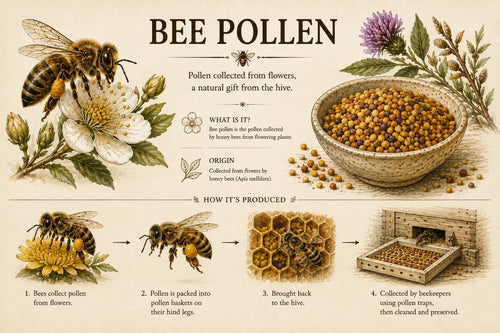
Worker bees collect sticky resins from tree buds, bark and young shoots using their mandibles. The resin is carried back to the hive in pollen baskets on their hind legs.
Inside the hive, bees mix the resin with beeswax and enzymes to form propolis, which is then used wherever the colony requires reinforcement or sealing.
Beekeepers collect propolis using specially designed collection mats or by carefully scraping it from hive surfaces.
History & Traditional Uses
Propolis has been used for thousands of years in many cultures. Ancient Egyptians are believed to have used it during mummification, while the Greeks and Romans valued it for a variety of traditional purposes. It has also appeared in traditional practices across Europe, Asia, and South America.
These historical uses are part of traditional knowledge and do not necessarily reflect current scientific evidence.
Naturally Occurring Compounds
- Plant resins
- Beeswax
- Essential oils
- Polyphenols
- Flavonoids
- Phenolic acids
- Aromatic compounds
- Trace minerals
The exact composition varies with the botanical sources available to the bees.
Interesting Facts
- Honey bees use propolis as a building and sealing material inside the hive.
- The word propolis comes from the Greek words pro (“before”) and polis (“city”), meaning “defence of the city.”
- No two propolis harvests are exactly the same because local plants determine its composition.
- The aroma of propolis varies from sweet and resinous to woody, depending on its botanical origin.
How We Use It at EirHolt
At EirHolt, we source raw propolis from trusted beekeepers who carefully harvest it from healthy hives. We gently clean and grind the raw propolis ourselves into a fine powder before incorporating it into selected products. By working with minimally processed propolis, we aim to preserve its natural characteristics while celebrating one of the hive’s most remarkable creations.
Related Reading
- Raw Honey
- Leatherwood Honey
- Bee Pollen
- Bee Bread
- Royal Jelly
- Beeswax
Products Containing This Ingredient
Information on this page is provided for educational purposes only and is not intended as medical advice. Historical and traditional uses do not necessarily reflect current scientific evidence.
0 comments